
One article a day, three levels your way.
Longer sentences, more descriptive words (about B1)
Tap a sentence to start from there.
Price: Why Does the Same Water Cost More Here?
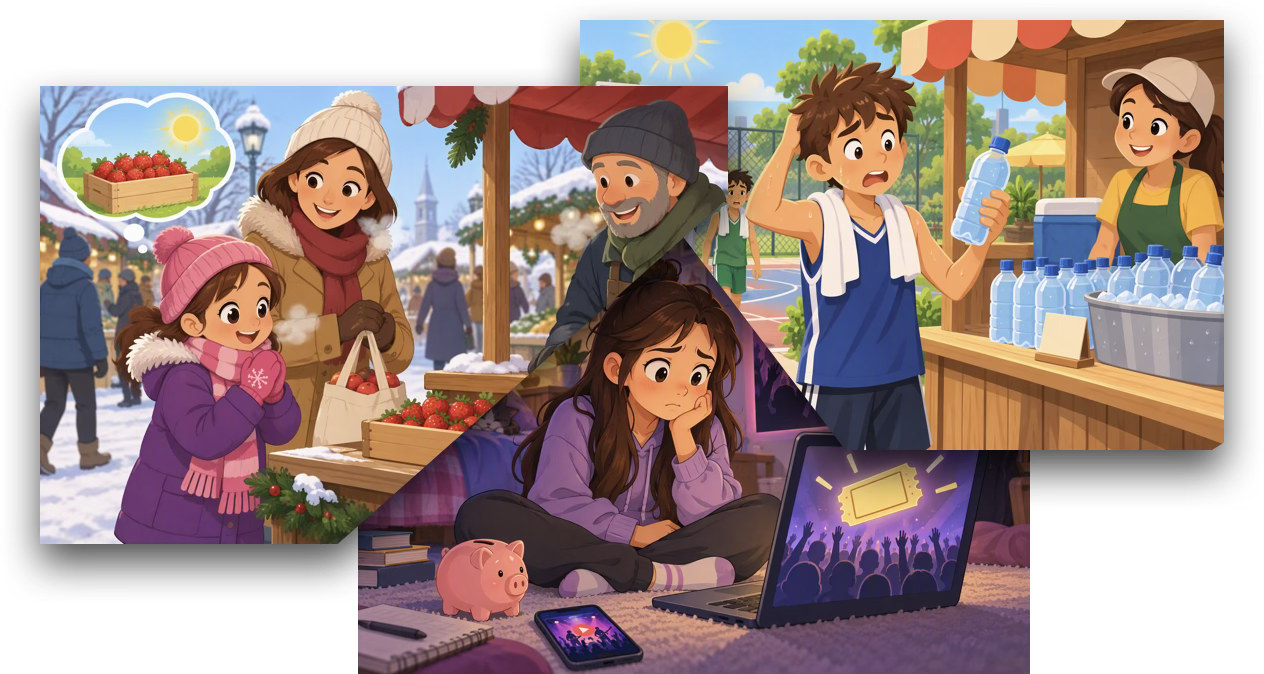
On Saturday, Tom and his friends play basketball at a sports park. It is a hot day, and after the game Tom is very thirsty. He walks to the small shop in the park and sees a bottle of water. The price is $6.
“$6?” Tom says. “At the shop near my school, this bottle is only $2!” But he is too thirsty to wait, and the next shop is far away. He pays and drinks the water fast.
Tom’s question is a good one. Why can the same bottle of water have different prices? To answer it, we need to understand price. A price is the amount of money you pay to get something. A pencil has a price. A phone has a price. Even a bus ride has a price.
Who decides a price? Usually, the seller and the customers decide it together. The seller has costs. He must pay for the goods, the shop, and the workers, so he cannot sell at a price that is too low. Customers want to pay less. If the price is too high, they will walk away. A good price is a number that both sides can accept.
Prices also change. Two things matter a lot.
First, how many people want the item. At a sports park on a hot day, many people want cold water at the same time. When more people want something, the seller can raise the price, and customers will still buy.
Second, how much of the item there is. Imagine a farmer who has a lot of apples. If he wants to sell all of them, he may lower the price. Now imagine a storm destroys most of the apples. There are only a few left, so the price goes up.
Prices also give us useful information. A high price often tells us that something is popular or hard to find. A low price often tells us that there is plenty of it. When we look at prices, we can decide what to buy now, what to buy later, and what to skip.
Now let’s go back to Tom. Why was the water $6? The shop in the park is far from other stores, so thirsty players have few choices. Many people want water after their games. Also, the shop owner has to bring the water a long way. All of this makes the price higher than the price near Tom’s school.
Tom now understands that a price is more than a number on a label. It is the result of what sellers need and what customers want. The next Saturday, Tom has a smart plan. He buys two bottles of water near his school for $2 each and carries them to the park. His friends laugh, but when the game ends, they all ask him the same question: “Can I have some of your water?”
Original ReadLevels article.
Select Vocabulary or Quiz to practice.
Vocabulary
6 key words — tap a word for meaning and examples
Quiz
5 questions