
One article a day, three levels your way.
Longer sentences, more descriptive words (about B1)
Tap a sentence to start from there.
A Deal at the Lunch Table
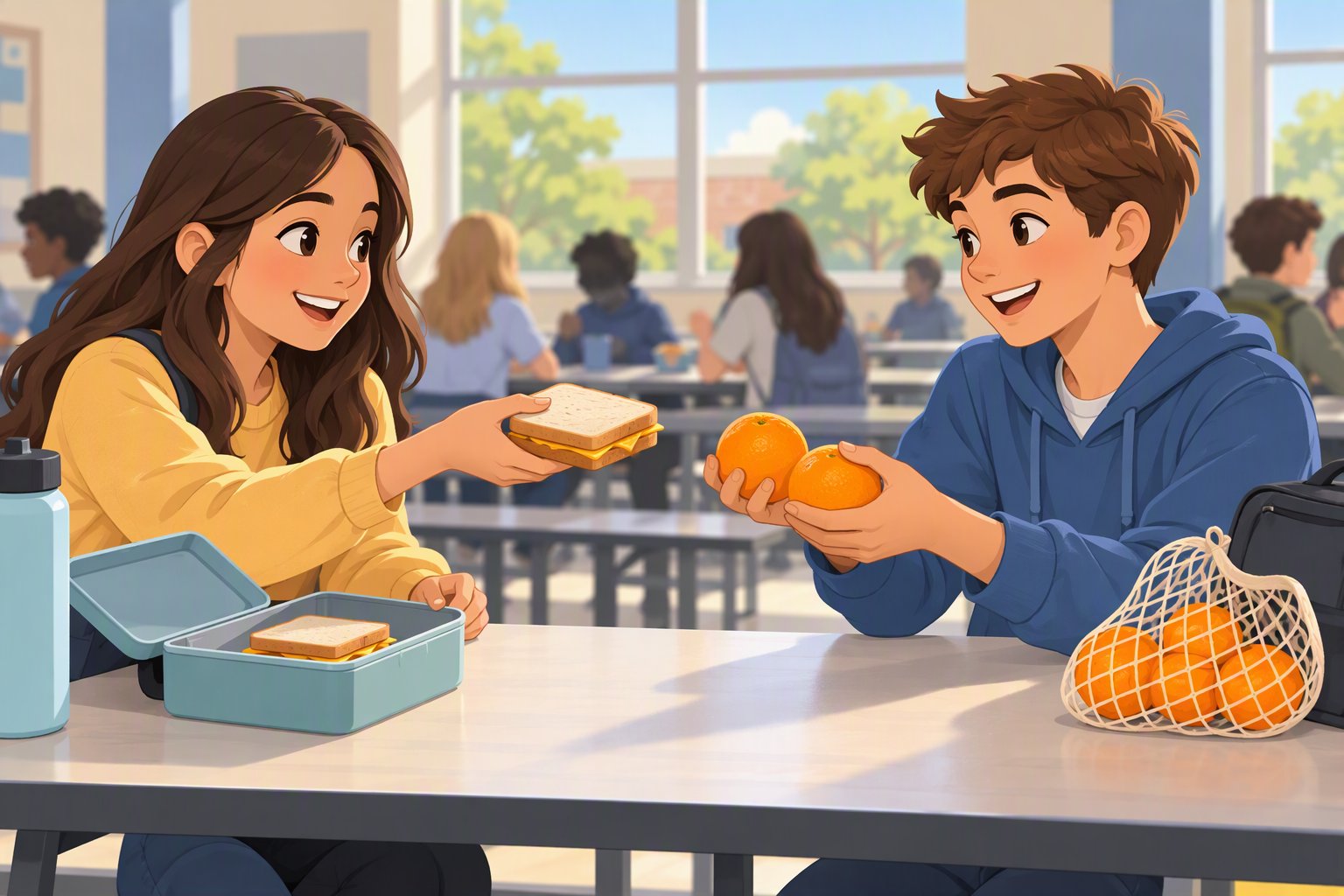
At 12 o’clock, Mia opens her lunch box at school. Her mom packed two cheese sandwiches today, but Mia only wants one. She also feels like eating something fresh.
Across the table, her friend Jack has a big bag of oranges. His dad packed 4 of them, and Jack is not sure he can finish them all. He also looks a little hungry.
“Do you want to trade?” Mia asks. “I’ll give you one sandwich. You give me 2 oranges.” Jack thinks for a second and smiles. “Deal!”
What Mia and Jack just did is called an exchange. In an exchange, each person gives something away and gets something in return. It sounds simple, but there are two important ideas behind it.
First, an exchange is a free choice. Jack could say no, and Mia could walk away. If someone forces you to give up your things, that is not a real exchange.
Second, both sides expect to be better off. How can that be? The answer is that the same thing can be worth different amounts to different people. Mia already has 2 sandwiches, so the second one is not very useful to her, but a fresh orange is. Jack has too many oranges, so a sandwich is worth more to him than 2 extra oranges. Each person gives up something they need less and gets something they need more.
We make exchanges every day. When you buy a drink at a shop, you give money and get a drink. When your mom goes to work, she gives her time and skills, and the company gives her pay. Then she uses that pay to buy food for the family.
Money makes exchange much easier. Imagine a farmer who wants new shoes, but the shoemaker does not want any eggs. Without money, they could waste a lot of time looking for the right match. With money, the farmer sells eggs to anyone, then buys shoes from the shoemaker.
Exchange also helps people do what they do best. A baker makes bread all day, and a farmer grows vegetables. Neither one has to make everything alone. They exchange, and both families get more food and more choices than they could make on their own.
Back at the lunch table, Mia bites into a sweet orange while Jack enjoys his sandwich. Nobody lost anything today. They both have a better lunch than before, and all it took was one small question: “Do you want to trade?”
Original ReadLevels article.
Select Vocabulary or Quiz to practice.
Vocabulary
6 key words — tap a word for meaning and examples
Quiz
5 questions